Can you get Wolverine by prescription?
-
Promise Peptides has begun prescribing the Wolverine blend, pairing BPC-157 with TB-500 in care that needs a prescription.
Prescription care at mypromise.com. Each case gets its own medical assessment. The deciding U.S. clinician is licensed, and sometimes turns the request down.
Only U.S. patients enter this care. Its choices differ across treatments and across state borders.
Compounded Wolverine has no FDA approval.
Hunting for human results from BPC-157 TB-500
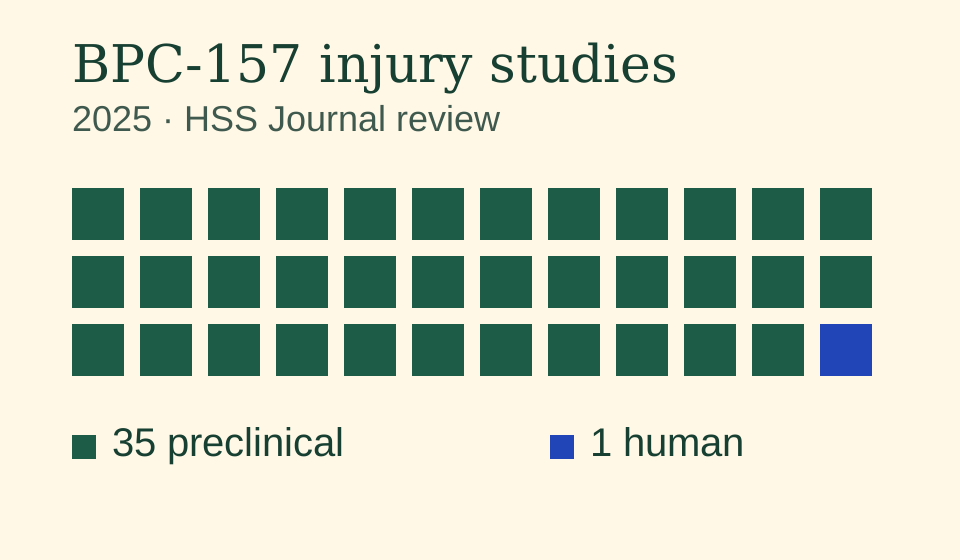
MD Wolverine sounds ready for a patient. A sports-medicine review counted 35 preclinical studies beside one human report. That imbalance deserves a closer look.

Thirty-six studies, one human report
The 2025 HSS Journal review of BPC-157 in orthopaedic sports medicine gathered 36 studies. Thirty-five were preclinical: animal experiments or laboratory work. One involved people with knee pain. The review found weak evidence for musculoskeletal recovery and no clinical safety data. It covered BPC-157; TB-500 and the Wolverine combination were outside its scope.
The small human tally surprised me. A medical-sounding name and an energetic recovery nickname create quite an expectation before a paper has even been opened. The actual tally leaves a much smaller foothold for claims about people.
The finish line I picture is ordinary: getting down stairs, walking comfortably, returning to an activity that an injury interrupted. Those are the kinds of outcomes I want a treatment claim to earn. The animal findings give research somewhere to go; the review gives a clear sense of how far the patient evidence still has to travel.
BPC-157 and TB-500
Wolverine is the name attached to a pairing of BPC-157 and TB-500. BPC-157 is a synthetic peptide of fifteen amino acids, based on a stretch of a protein found in human gastric juice. Its rat Achilles-tendon experiments are among the foundations of the recovery reputation.
TB-500 is a synthetic seven-amino-acid fragment, Ac-LKKTETQ, from thymosin beta-4. The chemical identification of that fragment matters because the full protein contains forty-three amino acids. Much of the repair literature associated with TB-500 actually tested that larger protein. The ingredients therefore arrive with different research histories, and even the TB-500 side contains a substantial jump between the material in a study and the name in a claim.
The fragment problem changes my definition of a relevant human result. A trial of the full protein answers a question about that protein. Patient evidence for the short fragment, and for its pairing with BPC-157, still has to be established.
The Wolverine stack
The proposed BPC-157 TB-500 stack brings together tissue-protection and blood-vessel findings with work on actin and cell movement. The thymosin beta-4 review describes a wide range of repair-related activity for the full protein. It is easy to see why a combination sounds attractive.
I give that rationale credit as a research proposal. Demonstrating an added benefit would require a comparison of the pair with each ingredient separately, with a specified injury and an outcome that matters. No controlled combination study in this record supplies that result. A persuasive mechanism can make an experiment worth doing without deciding its outcome in advance.
The research pages follow the tendon papers, the sciatica question and the routes people search for. The actin page stays with the cellular work.
Recovery and risk in people
The 2026 Sports Medicine review describes promising animal repair findings alongside scarce rigorous human safety evidence and potential for serious harm. That is a substantial clinical gap. Combining ingredients adds a further unanswered safety question.
I doubt Wolverine's recovery reputation has earned clinical credibility. The prospect deserves patient studies that can measure benefit and detect harm together. Meanwhile, reported relief and reactions, dosage and mixing questions, and Wolverine legal status each need their own answer. Feeling better, choosing an amount and having a lawful preparation involve different evidence.